ISO 9001 CERTIFIED · CONSULTANT APPROVED · EXPORTING SINCE 2005

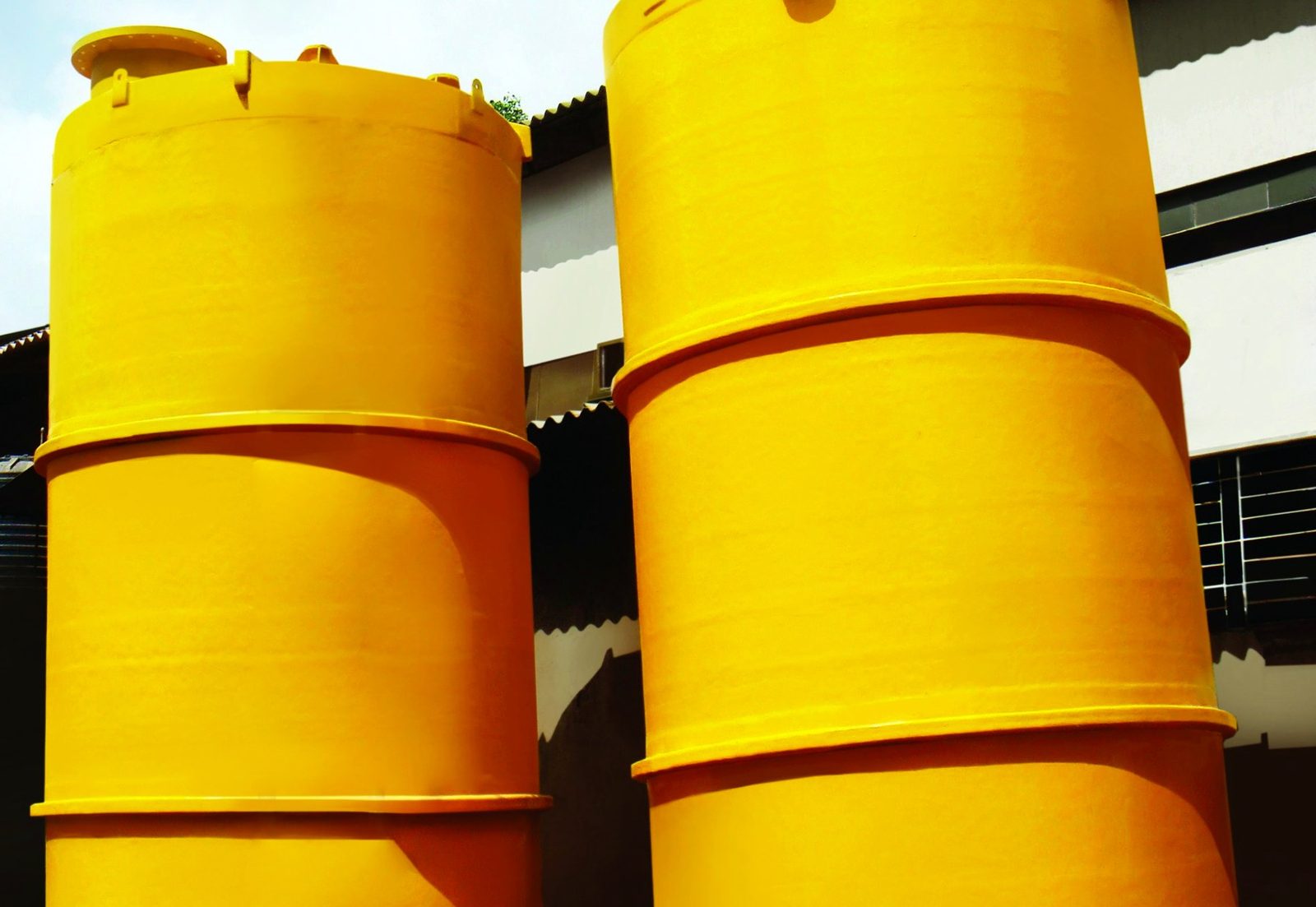
FILAMENT-WOUND FRP STORAGE TANKS
STORAGE & PROCESS · TANKS
FRP chemical storage & process tanks, 10 m³ to 300 m³
Filament-wound and hand lay-up tanks in FRP, PP/FRP and HDPE/FRP, for acids, alkalis and process liquors. Designed to BS 4994 and EN 13121 and tested before despatch.
1,000+
Tanks delivered, 10 m³ to 300 m³
300 m³
Largest FRP tank — Ø 6,000 × 8,000 mm
~100
Tanks built each year
BUILT TO BS EN 13121 · DVS 2205 · AD 2000-MERKBLATT
01 — CONFIGURATIONS
Four ways to build a tank, chosen by size and service.
Construction method follows the duty. Filament winding for cylindrical strength, hand lay-up for complex shapes, thermoplastic liners for chemistry, and site fabrication when it will not fit on a truck.
TYPE 01
Filament-wound FRP
Continuous winding for the best hoop strength per kilogram. The default for vertical storage.
CYLINDRICAL STORAGE
TYPE 02
Hand lay-up FRP
For conical bottoms, rectangular sections and non-standard shapes.
PROCESS & RECIRCULATION
TYPE 03
Dual-laminate PP/FRP, HDPE/FRP
A thermoplastic liner for chemical resistance, FRP for structure.
AGGRESSIVE SERVICE
TYPE 04
Site-fabricated tanks
Built at your site when the diameter exceeds what can be transported.
50 M³ AND ABOVE
02 — SPECIFICATION
The envelope, in numbers.
The laminate schedule is worked out against the governing code and checked by FEA analysis before any prototyping is done.
PARAMETER
RANGE / CAPABILITY
Capacity
10 m³ to 300 m³ (10,000 – 300,000 L)
Largest executed
Ø 6,000 mm × 8,000 mm shell
Construction
Filament wound · hand lay-up · site fabricated
Materials
FRP · PP/FRP · HDPE/FRP · PVC/FRP
Resin systems
Isophthalic · bisphenol · vinyl ester
Design codes
BS EN 13121 · DVS 2205 · AD 2000-Merkblatt
Structural verification
FEA analysis before prototyping
Testing
Hydro test · laminate DT and NDT in house
Design temperature
[confirm range]
Annual output
~100 tanks between 10 m³ and 200 m³
Values in square brackets are placeholders for your engineering team to confirm. Every unit is sized against the actual duty.
03 — APPLICATIONS
What our tanks hold
Acids
Hydrochloric · sulphuric · nitric · phosphoric · hydrofluoric (with liner)
Alkalis and oxidisers
Caustic soda · sodium hypochlorite, with the appropriate resin
Process liquors
Plating and pickling solutions · brine · effluent · scrubber liquor
Industries
Chemicals · pharma · metals · water treatment · paints
04 — HOW WE SIZE IT
What decides the laminate.
Chemistry and temperature. These choose the resin and whether a thermoplastic liner is needed.
Specific gravity and head. These set the hoop load and the structural laminate thickness.
Installation conditions. Indoor or outdoor, wind and seismic loads, and the foundation.
Connections and access. Nozzle loads, manways, ladders, platforms and level instruments.
TO QUOTE, SEND US
Chemical stored and concentration
Operating temperature
Capacity or diameter × height
Indoor or outdoor installation
Nozzle schedule, if available
Start an enquiry
Operating temperature
Capacity or diameter × height
Indoor or outdoor installation
Nozzle schedule, if available
05 — CONSTRUCTION
What goes into every tank
01
Corrosion barrier
A resin-rich inner layer with surfacing veil — the part that actually meets the chemical.
02
Structural laminate
Filament-wound or hand-laid glass to carry the hydrostatic and external loads.
03
UV-resistant exterior
An external topcoat for outdoor installations.
04
Nozzles, manways and lugs
Reinforced connections, lifting lugs and hold-down lugs sized to the code.
05
Access
Ladders, platforms and handrails where required.
REFERENCE INSTALLATION
3 + 3
80 M³ AND 125 M³ STORAGE TANKS
Pigments manufacturer, Maharashtra
Three 80 m³ and three 125 m³ FRP storage tanks, supplied as one package.
06 — IN SERVICE
Units we have built and commissioned
FRP STORAGE TANKS
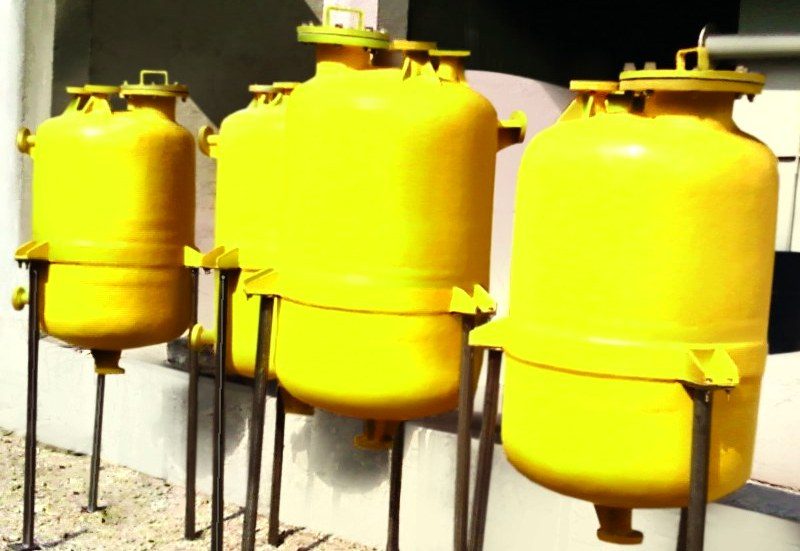
PROCESS VESSELS
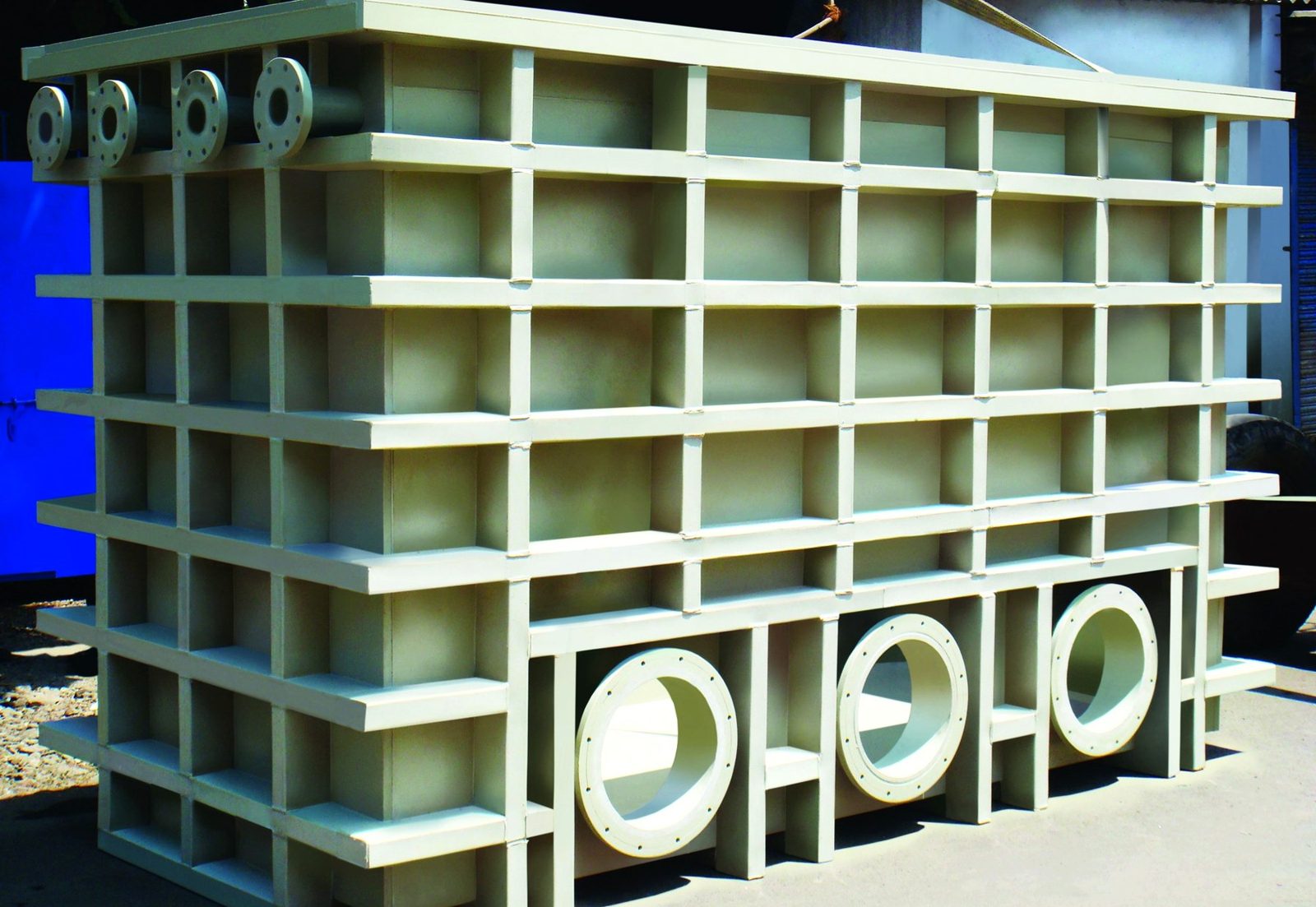
PPH PROCESS TANK
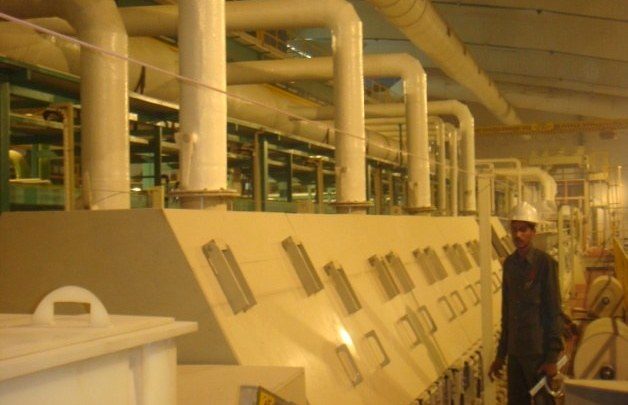
IN FABRICATION · MANKOLI
07 — QUESTIONS
What engineers ask us first
These answers are also written for search. Each question is a query buyers type into Google, which is why the FAQ block sits on every equipment page.
Why FRP rather than MSRL or stainless steel?+
FRP resists a wide range of acids and chlorides without a rubber lining to maintain, weighs less, and usually costs less than the alloy that would do the same job.
Filament wound or hand lay-up?+
Filament winding gives the best strength for cylindrical storage. Hand lay-up suits conical bottoms, rectangular shapes and complex fittings.
When do I need a dual-laminate tank?+
When the chemical would attack even a premium resin — hydrofluoric acid, some oxidisers, high-purity service. A PP, HDPE or PVDF liner handles the chemistry and FRP carries the load.
What is the largest tank you can build?+
300 m³ executed, at Ø 6,000 × 8,000 mm. Beyond transportable diameters we fabricate at site.
How are tanks tested?+
Hydrostatic testing before despatch, with destructive and non-destructive laminate testing in our own facility.
ENQUIRY
Pick the equipment. We will send you the data sheet.
Choose the equipment you need. We will take three details, then send you the enquiry data sheet for that product — the one our engineers use to size and quote.
Already know what you need? Download data sheets directly
ENQUIRY DATA SHEET
Scrubbing systems
The sheet arrives by email immediately. Fill it in and send it back, and an engineer replies with a sized proposal.
RELATED EQUIPMENT

Bhavi Plast
FRP and dual-laminate process equipment, engineered, built, installed and maintained under one contract. Established 1977.
EQUIPMENT
APPLICATIONS
HCl fume scrubbing
Cl₂ and NH₃ scrubbing
H₂SO₄ mist removal
Flue gas desulphurisation
Pickling line exhaust
Solar PV and semiconductor exhaust
Cl₂ and NH₃ scrubbing
H₂SO₄ mist removal
Flue gas desulphurisation
Pickling line exhaust
Solar PV and semiconductor exhaust
CONTACT
603 Dev Corpora, Cadbury Junction,
Khopat, Thane (W) 400 601
Maharashtra, India
Plant — Mankoli, Bhiwandi
+91 22 4970 9140
mb@bhaviplast.com / jm@bhaviplast.com
Khopat, Thane (W) 400 601
Maharashtra, India
Plant — Mankoli, Bhiwandi
+91 22 4970 9140
mb@bhaviplast.com / jm@bhaviplast.com
© 2026 BHAVI PLAST PRIVATE LIMITED
PRIVACY · TERMS · HSE POLICY · SITEMAP